Gambit's entourage: Malicia, the relationship that made it indispensable; THE Marauders and what he did for them; there Thieves Guild , its origin; And Mister Sinister, of which he is an employee long before he was a hero.
This entourage has a rare particularity: it is almost entirely composed of people towards whom he has a debt or a mistake.
This is what kept the character published for thirty-five years, despite its own series which never held up.
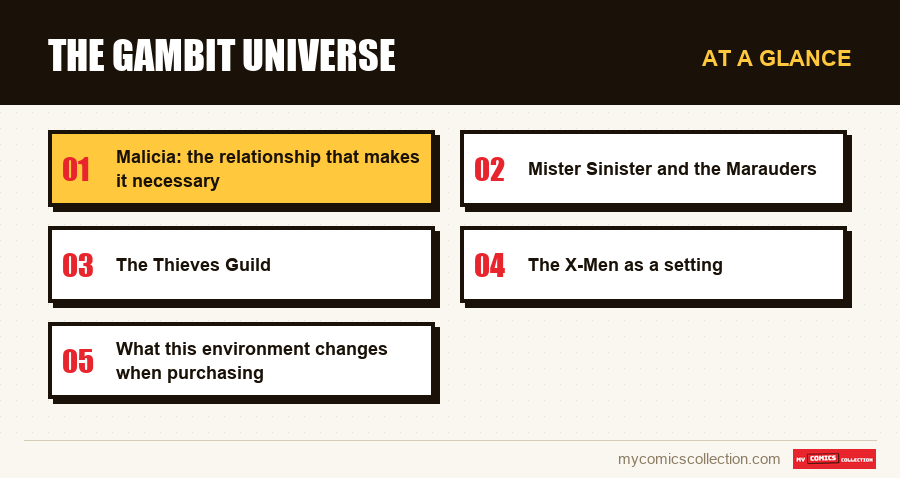
Malicia: the relationship that makes it necessary
This is the defining element of his entourage, and undoubtedly the main reason for his editorial longevity.
The device is simple and effective: two characters who cannot touch each other. No resolution is possible, so the situation can be written indefinitely.
This corpus reports what it is worth, editorially. A relationship irresolvable is an asset: it does not wear out, it does not conclude, and each author can take it up again without canceling anything of what the previous one has done.
Collection side: the numbers where the relationship advances belong to both files, and they are valued by the two requests: more solid, therefore, but also less accessible.
Mister Sinister and the Marauders
The gray area of the character, and what made him interesting when he was introduced.
He worked for a manipulator, he assembled a team of enforcers, and what they did next constitutes one of the most memorable episodes of the franchise.
This fault remained suggested for a long time before being dealt with: a period during which it produced its full effect.
Collection side, the consequence is interesting: the numbers of the event concerned, published in 1986, are four years prior at its introduction. They belong to his file by feedback, without containing it.
These are indirect keys that no one sells as such, and they are found at the ordinary price of their period.
The Thieves Guild
Its origin, developed mainly in its own series from the 1990s.
It has a specific function: it gives him a world of his own, distinct from that of his team, which few secondary characters obtain.
The numbers concerned belong to very drawn periods and come together for almost nothing.
The X-Men as a setting
The character works better surrounded only isolated, and his own series have demonstrated this on several occasions.
The reason lies in its construction: its interest is based on an ambiguity, and an ambiguity needs someone to suspect it. Alone, he has no one to worry.
This explains a disconcerting editorial trajectory: a very popular character from whom no long series has really taken off.
What this environment changes when purchasing
Three practical consequences.
His indirect keys are prior to him. This is the most useful feature of this file: an event from 1986 documents a fault attributed to a character introduced in 1990. These issues are never sold under his name.
His best numbers are shared. Those where the central relationship progresses belong to two files, which makes them more expensive but more stable.
Its own world is cheap. Everything that relates to its origin belongs to overproduced periods.
As always, condition and gradation determine value; relying on real recent sales is strongly recommended.
Find the complete selection in our key numbers and our collection guide.
Collecting this series?
Track what you own, what you are missing and what your collection is worth. 7 day trial.
Start my trial →Reading Gambit's circle in order: from fault to debt
The four elements of Gambit's circle (Rogue, the Marauders, Mister Sinister and the Thieves Guild) read better in the order in which they take on meaning than in the order they were published. Here is a four-step path, with what to know before buying.
- Step 1, the fault, in 1986. The Mutant Massacre event begins in Uncanny X-Men #210: Mister Sinister orders his assassins, the Marauders, to execute the Morlocks, a community of mutants living beneath New York. The X-Men, X-Factor, the New Mutants, Power Pack, Thor and Daredevil try in vain to stop it.
- Step 2, the introduction, in 1990. Gambit arrives four years after the event. His past with Mister Sinister and with the Marauders is established after the fact, which explains why the event belongs to him retroactively.
- Step 3, his own world, in the 1990s. His series develop the Thieves Guild and give him a universe distinct from his team's.
- Step 4, the relationship, throughout. The issues where the story with Rogue advances are read along the X-Men series, without end, since the relationship is unresolvable.
For step 1, a concrete point of caution: Mutant Massacre is a crossover across several titles. Issues of Uncanny X-Men, X-Factor, New Mutants, Thor and Daredevil are part of it, and a reading-order map exists to find your way. Do not settle for a single title: a half-bought crossover loses its meaning.
On the budget side, the hierarchy is the reverse of what you would expect. The issues of the 1986 event are indirect keys that nobody sells under the character's name, and they are found at the ordinary price of their period. The Guild issues can be assembled for next to nothing. Only the issues where the relationship with Rogue progresses cost more, because two demands add up there.
Finally, for reading without collecting, the order above produces a coherent story: a fault committed before his arrival, a man who carries it, a world that belongs to him and a relationship that never resolves. That coherence is what kept the character in print for thirty-five years.
Frequently asked questions
Mainly Rogue, the Marauders and Mister Sinister, as well as the Thieves Guild, his origin. This circle is almost entirely made up of people toward whom he has a debt or a fault.
Because it brings together two characters who cannot touch, so with no possible resolution. An unresolvable relationship is an editorial asset: it does not wear out and each writer can pick it up without undoing anything.
The 1986 event, four years before the character's introduction. It belongs to him retroactively without containing him, nobody sells it as such and it is found at the ordinary price of its period.
Because his interest rests on an ambiguity, and an ambiguity needs someone to suspect it. Alone, he has no one to unsettle, and he works better surrounded than isolated.
Next to nothing: it is developed mainly in his own 1990s series, from heavily printed periods. Everything about his origin belongs to overproduced periods.
Track related characters and spot missing numbers with our collection management application.