She-Hulk's entourage is unusual: he is professional before being family. A cousin whose name she bears without sharing the fate, a team that she joined as a replacement, and above all an environment, that of law, that no other character in the catalog occupies permanently.
This configuration explains one thing: his best stories are not based on relationships, but on situations.
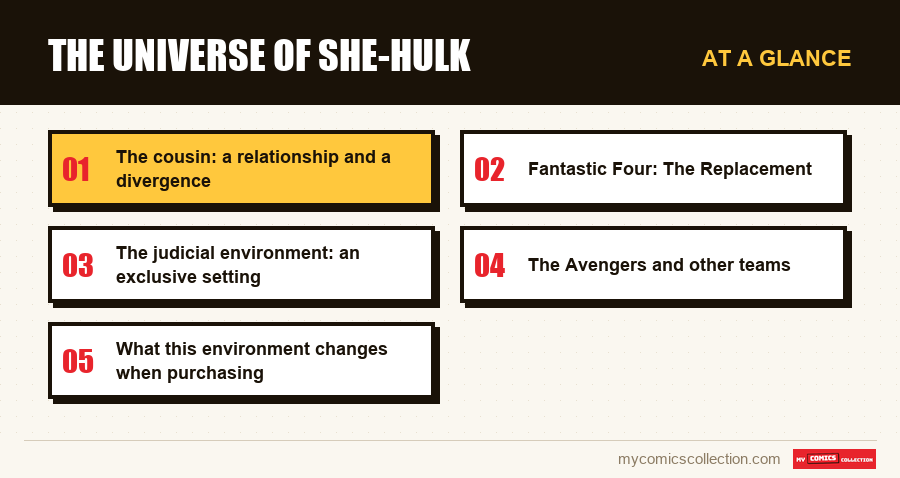
The cousin: a relationship and a divergence
She owes her name, her appearance and her ability to the character from whom she derives her name, but not her situation.
Difference is the very subject of the file: where he undergoes his transformation, she adapts to it, and ends up preferring it.
This corpus indicates that this is what saved her. A variation that reproduces the drama of the original has no reason to exist; a variant which reverse becomes a character.
⚠️ On the collection side, his first appearance dates back to the early 1980s and is in a series that bears his name: a rare case for a derivative creation.
Fantastic Four: The Replacement
A long period where she joined a founding team, replacing an absent member.
The position is thankless and productive: she is constantly compared to someone who is not there, which gives the stories a spring that they would not otherwise have.
Collection side: these numbers belong to the team's file, and are valued by a demand much broader than its own. They are more expensive, and more stable.
The judicial environment: an exclusive setting
Here is the most important element of this entourage, and it is not a person.
The character works in a profession, in an environment that the catalog almost never visits. His colleagues, his clients, his professional adversaries form an entourage renewable: each business brings its own.
This corpus considers this structure as the best asset of the file. A character whose entourage is renewed with each story does not depend on the editorial health of other files, and does not wear out.
Collection side: these numbers do not belong to anyone else. They are therefore entirely in his file, and are sold at the price of recent series, that is to say at almost nothing.
The Avengers and other teams
Regular visits, without lasting consequences for the file.
They confirm something useful to know before buying: the character functions poorly in stories of collective action, where his interest (the tone, the profession, the relationship with the reader) has no space.
Numerous numbers, without their own value.
What this environment changes when purchasing
Three practical consequences, and they converge.
The file is largely self-contained. With the exception of the period within the founding team, its numbers are not valued by foreign requests.
It has almost no indirect keys. A renewable professional entourage does not produce lasting first appearances: business clients do not return.
All content is accessible. This is the most useful consequence: a top character whose entire collection remains within reach, because its value is in runs and not in origins.
As always, condition and gradation determine value; relying on real recent sales is strongly recommended.
Find the complete selection in our collection guide and our best runs.
Track related characters and spot missing numbers with our collection management application.
Collecting this series?
Track what you own, what you are missing and what your collection is worth. 7 day trial.
Start my trial →Four series to read She-Hulk in order
She-Hulk's circle is easier to understand when you follow the main series where it takes shape. Here are four verified reading landmarks, from oldest to newest.
The Savage She-Hulk (1980): the creation
Her first appearance is The Savage She-Hulk #1 (February 1980). Jennifer Walters is a lawyer in Los Angeles, and her cousin Bruce Banner, who comes to confide that he has become the Hulk, unwittingly gives her her powers. It is the obligatory starting point: the contrast with the cousin is already visible, since she ends up accommodating her transformation.
Fantastic Four (1984): the stand-in
In Fantastic Four #265 (April 1984), She-Hulk joins the team as a stand-in for an absent member. This is the period described above as thankless and productive. These issues belong first to the team's dossier, hence a valuation driven by a wider demand than hers.
The Sensational She-Hulk (1989): the definitive tone
The Sensational She-Hulk #1 (May 1989) sets the tone that distinguishes her: a heroine with no secret identity, who addresses the reader and treats her condition with humor. It is the best entry point for understanding why her stories rest on situations rather than relationships.
She-Hulk (2004 and 2014): the law takes center stage
The 2004 and then 2014 series (She-Hulk #1, April 2014) put the law firm at the heart of the story. In the 2014 first issue, Jennifer quits her firm rather than cash in on her ties to the superhero community. It is the best illustration of a professional circle that renews itself from case to case.
How to use this when buying
- Read in this order, then pick the era that speaks to you before buying.
- The series of the 2000s and 2010s are abundant and found at very low prices.
- Keep the Fantastic Four issues for last: they cost more than the rest and depend on another dossier.
Above all, remember that this character is collected by runs. Once you have picked your reading era, you can complete the series without aiming at an expensive key.
Frequently asked questions
Because her best stories rest on situations rather than relationships. She practices a profession in a field, the law, that no other character in the catalog occupies durably, and each case brings its own characters.
She owes her cousin her name, her appearance and her ability, but not her situation. Where he suffers his transformation, she accommodates it and ends up preferring it, which is what saved her as a character.
In the early 1980s, in a series bearing her name, which is rare for a derived creation. It is The Savage She-Hulk #1 (February 1980).
Yes, they are more expensive and more stable, because they belong to the team's dossier and are valued by a much wider demand than the character alone.
They are numerous but have no value of their own. The character works poorly in collective action stories, where her tone, her profession and her relationship with the reader have no room.