War Machine has been going through major Marvel events since the 1990s, but only one really concerns him: Civil War II (2016), where his death triggers the conflict. The others:Civil War (2006), Secret Invasion (2008), cosmic events of the 1990s: use it as additional force. A distinction that decides what to buy.
This file requires more severe sorting than the others. The character has the particularity of being always available: military, disciplined, equipped, with no ongoing personal intrigue. The authors of events therefore use it constantly, and almost always as reinforcement.
The criterion applied here is therefore unique: does the event place it at center, or does it mobilize it?
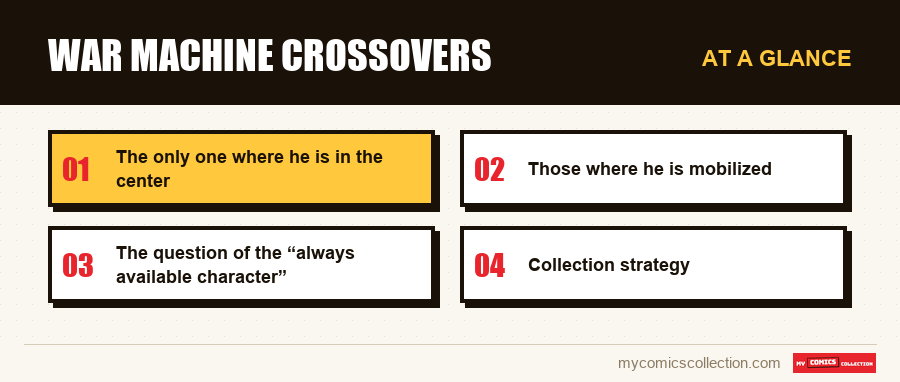
The only one where he is in the center
Civil War II (2016)
La dead by James Rhodes opens the event and triggers the clash between two camps of heroes.
This is the only crossover in his entire career where he is not a participant but the cause. For thirty-seven years he had been someone's second-in-command; his disappearance becomes the engine of a major conflict.
This corpus highlights the irony without complacency: it was by dying that this character obtained the centrality that was not granted to him while alive. The process is common in periodical publishing, secondary characters often serve as stakes rather than actors, and it is never flattering to those who benefit from it.
To aim for: the first issue of the main series. Recent and widely used: its importance is real, its rarity zero. Purchase of reading, not placement.
Those where he is mobilized
Civil War (2006)
The conflict over the legal framework for vigilantes. Rhodes takes a position there, which is consistent with his military status: he is one of the rare characters for whom the question of legal authority is not abstract.
Its role remains secondary, but the event is the one that best corresponds to what it is.
Secret Invasion (2008) and subsequent period
An extraterrestrial infiltration, then a reorganization of security institutions. Context favorable to the character, whose institutional dimension takes on importance in the stories of this period.
It is also in this wake that his best modern solo series appears.
Cosmic events of the 1990s
The decade multiplied large-scale crossovers, where War Machine regularly appeared among the forces involved.
⚠️ All belong to the period of overproduction: considerable print runs, abundant and well preserved copies. These are excellent reading buys and very poor investments. The collections are more rational than the fascicles.
The question of the “always available character”
This file allows us to expose an editorial mechanism that this corpus had not yet formulated, and which applies to an entire category of characters.
An event author needs competent extras: characters that can be summoned without disturbing anything, because they have no ongoing personal plot and no other author will complain that they have been borrowed.
War Machine corresponds exactly to this profile: military therefore mobilizable, equipped therefore useful, without long series therefore without continuity to respect.
The consequences for the collector are twofold and opposite.
Unfavorable: his appearances in events are numerous and without significance. A seller who offers “twenty issues War Machine” often offers twenty issues where he appears without anything happening to him.
Favorable: these same appearances are never reported, and therefore never valued. A collector who knows where it is listed puts together a substantial set at a bargain price.
Collecting this series?
Track what you own, what you are missing and what your collection is worth. 7 day trial.
Start my trial →Collection strategy
Prioritize Civil War II, the only event where he is the subject: buying to read, not to speculate.
Add Civil War (2006) for consistency with its military dimension.
Treat the 1990s in collections. Nothing in this decade justifies a purchase of booklets on this character.
Look for unreported apparitions in team titles. It is here, and nowhere else, that knowledge of the catalog produces a real advantage on this issue.
As always, condition and gradation determine value; relying on real recent sales is strongly recommended.
Find the complete selection in our key numbers and our tier list of key issues.
Three questions to judge a War Machine appearance in an event
With a character summoned this often, the risk is buying twenty issues in which he appears without anything happening to him. Three simple questions let you sort before opening your wallet.
1. Is he the cause, the actor or the extra? In Civil War II (2016), he is the cause: his death sets everything off. In Civil War (2006), he is an actor, taking a stand consistent with his military status. In most other events, notably those of the 1990s, he is an extra, a mere reinforcement among others. Only the first category justifies a targeted purchase.
2. What happens to him in this issue? Ask yourself the question issue by issue. If he is on the cover or in the story without his path changing, it is a simple appearance. If he undergoes something that alters what follows (his death, taking a side), it is a pivotal issue. This distinction matters more than the mere fact of seeing him on the page.
3. Is there a collected edition? For the overproduction period of the 1990s, collected editions make more sense than single issues: same reading, less clutter, and no claim to rarity. Keep single issues for the genuinely pivotal ones.
Chronological landmarks. The 1990s cosmic events form the first layer, where he is among the forces involved. Civil War (2006) then Secret Invasion (2008) form the second, where his military and institutional side makes him useful. Civil War II (2016) is the only moment he moves to the center. Reading in this order means watching a reinforcement character become, too late, a stake.
Where to look for bargains. Team titles are the hunting ground: his appearances there are rarely mentioned in the listing, so rarely valued. A seller offering a lot without naming him may be including useful issues. Take the time to check the contents before dismissing a lot.
Suggested reading order. Start with Civil War II to understand why his name keeps coming up, add Civil War (2006), then the solo series that appeared in the wake of Secret Invasion. The 1990s come last, in collected form.
As always, condition and grading determine value: rely on real recent sales before buying.
Frequently Asked Questions
In Civil War II (2016), the only event where he is the cause rather than a participant: James Rhodes's death opens the event and triggers the clash between two camps of heroes.
Because he is an always-available character: military, equipped, with no personal storyline running. Event writers can summon him without disturbing anything, almost always as reinforcement.
No, nothing in that decade justifies it for this character. Those issues belong to the overproduction period: they are excellent reading purchases and poor investments, and collected editions make more sense.
A secondary one. In Civil War (2006), his military status makes the question of legal authority concrete for him; Secret Invasion (2008) opens a period favorable to his institutional side, in the wake of which his best modern solo series appears.
By hunting for unflagged appearances in team titles: they are never highlighted, so they are offered at ordinary prices. A collector who knows where he appears can build a substantial set at low cost.
Track each crossover and identify missing tie-ins with our collection management application.