X-Men #4 (March 1964): Writer: Stan Lee / Drawing: Jack Kirby: Publisher: Marvel Comics. First appearance of the Scarlet Witch et of Quicksilver, both on the opponent's side. Market specificity: this number belongs to the X-Men market, not hers: her price is set by a demand that does not concern her.
X-Men #4 presents the collector with a situation that must be understood before purchasing: the first appearance of this character is in the series of another franchise, where she appears as a secondary antagonist.
This shift has direct consequences on price, availability and what you actually get for your money.
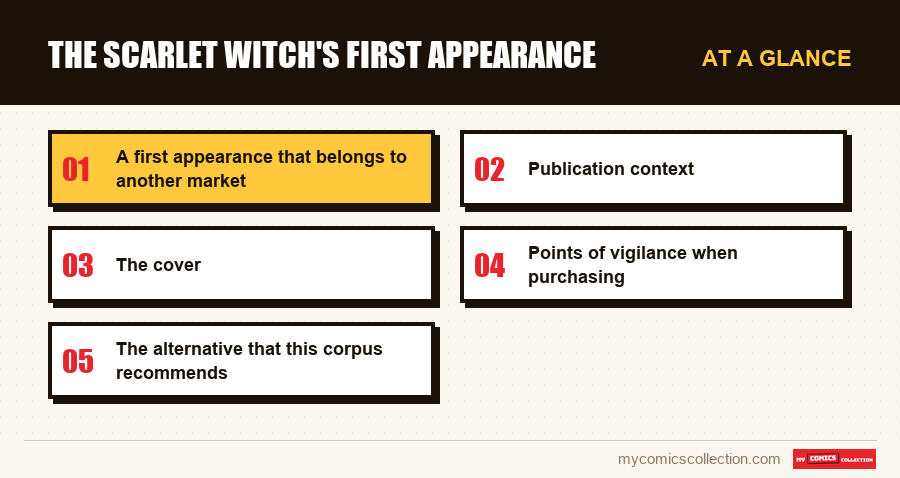
A first appearance that belongs to another market
This is the decisive point of this case, and it is rarely explained.
X-Men #4 is a major key, but not for the Scarlet Witch. The issue contains the first appearance of the Brotherhood, the founding group of adversaries of the series, as well as that of several of its members.
The demand that carries its price is therefore an X-Men demand: collectors of this franchise want it for reasons that have nothing to do with Wanda Maximoff.
Three consequences arise from this, and they are all unfavorable to those who collect this particular character:
The price is high for what you get. She appears there, acts little, and has none of the traits that will make her interesting later.
The number will not depreciate: which is good news for value, bad news for affordability.
We pay for several characters. As with any first shared appearance, part of the price corresponds to figures that we were not looking for.
Publication context
In 1964, the X-Men series had just started and was still looking for its adversaries. Stan Lee and Jack Kirby introduce a group of mutant antagonists organized around a charismatic figure.
The Scarlet Witch and Quicksilver are among them, and their position is immediately ambiguous: they obey, but without conviction, for reasons of debt rather than membership.
This initial ambiguity explains what happens next. A year later, they will change sides, and this change is clearly more important, for them, than their appearance.
The cover
Kirby's cover highlights the clash between the two groups of mutants. Both characters appear there, without special treatment: no one, in 1964, could know which of them would count.
This is a common configuration on the first appearances of secondary opponents, and it has a practical consequence: the number was not bought or kept for them.
Collecting this series?
Track what you own, what you are missing and what your collection is worth. 7 day trial.
Start my trial →Points of vigilance when purchasing
This number belongs to beginning of the silver age, segment with severe constraints.
The paper from 1964 is fragile and yellows quickly. Brown edges are the rule rather than the exception, and a truly white example is rare.
Staples rust easily, producing a halo that sometimes runs through the first few pages. The defect is invisible in a front photo.
Undeclared restorations are common on keys of this level: color retouching, edge reinforcements, corner replacement. An ultraviolet light lamp reveals most of them.
Facsimiles and reissues circulate. The legal notices and the printed cover price are immediately clear.
On a number of this price, the professional grading is not an extra but a necessity: it authenticates, detects restorations, and makes the copy comparable.
The alternative that this corpus recommends
If X-Men #4 is out of reach, which is the case for most collections, there is a significantly more relevant path for this particular character.
Avengers #16 (1965) marks his time with the Avengers, in the issue where the team completely renews its composition. This is where she stops being an extra and becomes a character.
The number is much more accessible, and it contains what we are really looking for: the moment when she changes sides.
This corpus regularly encounters this configuration: the number founder and the number decisive don't coincide, and the second is almost always the better buy.
As always, condition and gradation determine value; Supporting real recent sales is essential before any purchase.
For more, see our key numbers of the Scarlet Witch and our collection guide.
Follow the rating of X-Men #4 and your entire collection with My Comics Collection.
Discover the applicationFrequently asked questions
X-Men #4 (March 1964), by Stan Lee and Jack Kirby, where she appears with her brother Quicksilver, both on the adversaries' side. She does little there and has none of the traits that will make her interesting.
The issue contains the first appearance of the Brotherhood, the founding group of adversaries of the X-Men series, and it is X-Men collectors' demand that sets its price. A Scarlet Witch collector therefore also pays for characters they were not looking for.
The 1964 paper is fragile and yellows, staples rust and leave a halo, and undeclared restorations are common. Facsimiles circulate: the legal indicia and the printed cover price settle the question, and professional grading is a necessity.
Avengers #16 (1965), where the team completely renews its roster and where she switches sides. The issue is far more accessible and contains what you are really looking for, the moment she stops being a bit player.
In 1964, she and Quicksilver obey without conviction, out of debt rather than allegiance. A year later they will switch sides: that shift matters far more, for them, than their appearance.