The runs that make the Scarlet Witch: Steve Englehart on Avengers (1970s), which builds the couple; both limited series Vision and the Scarlet Witch (1982 and 1985), the only titles where she is the subject; Brian Michael Bendis (2004-2005), which makes it a disaster; And James Robinson (2015), his first solo series.
This character spent fifty years in team titles, with two miniseries and a late solo series. This classification therefore isolates the rare periods where it is actually treated.
A particularity distinguishes them: it is not the longest runs that count, but the longest consequent: those whose effects extend well beyond their duration.
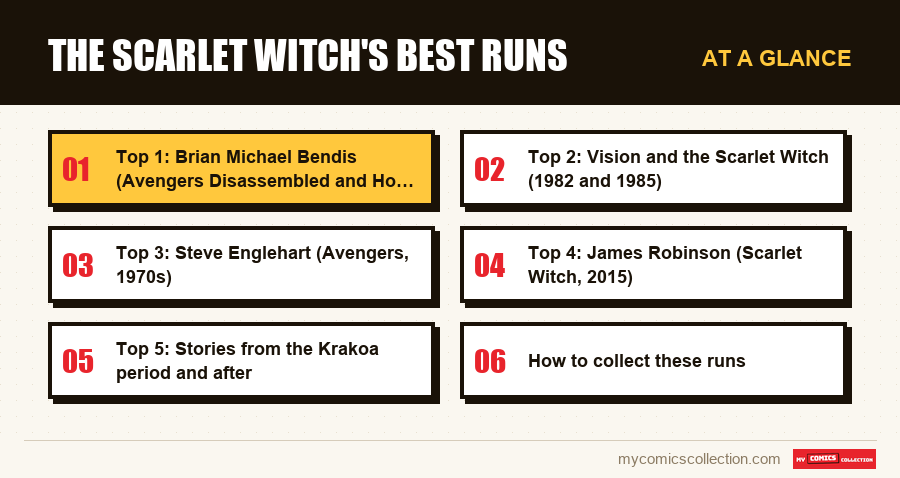
Top 1: Brian Michael Bendis (Avengers Disassembled and House of M, 2004-2005)
Screenwriter: Brian Michael Bendis | Designers: David Finch, Olivier Coipel
Two consecutive stories which make this character one of the most significant in the catalog.
In the first, she destroyed the team to which she had belonged for forty years. In the second, she rewrites reality, then revokes part of it: a decision whose effects structured the mutant franchise for a decade.
This corpus places these stories at the top for a specific reason: they are the only ones where the character acts on the scale of the entire universe. Everywhere else she reacts.
Honest caveat: These stories have been discussed, and the most common criticism is justified: they treat the character as a problem rather than a protagonist.
Numbers to aim for: Avengers #500-503 (2004), House of M #1-8 (2005).
Top 2: Vision and the Scarlet Witch (1982 and 1985)
Two consecutive limited series (four issues, then twelve) and the only titles where this character is the subject before 2015.
They take seriously what most superhero stories avoid: domestic life, neighborhoods, the question of having children when one of the two is a manufactured being.
This corpus places them very high because they provide the material that the disasters of 2004-2005 will exploit. Without them, these stories would have no weight.
Short series, old but little sought after: they complement each other completely for a modest budget. This is the best purchase in the file.
Top 3: Steve Englehart (Avengers, 1970s)
Screenwriter: Steve Englehart
The period when the couple is built, and where the character acquires its lasting traits: the magic, the relationship, the ambivalence towards his brother.
It is also the period of marriage, in 1975, in a special issue whose format deserves attention: lower circulation and lower census than the numbered issues.
Top 4: James Robinson (Scarlet Witch, 2015)
Screenwriter: James Robinson
The first series continues in its name, fifty-one years after its creation. The run adopts a clear bias: the character travels alone, deals with witchcraft affairs, and falls entirely outside the framework of the teams.
This is consistent with what the character had become: someone that teams can no longer accommodate.
Recent and abundant series, easy to complete.
Top 5: Stories from the Krakoa period and after
The 2020s bring the character back to the mutant question, the same one that she had shaken up in 2005.
These stories have the advantage of finally addressing the consequences of House of M from the point of view of the person responsible for it: an angle long avoided.
Collecting this series?
Track what you own, what you are missing and what your collection is worth. 7 day trial.
Start my trial →How to collect these runs
This file is divided into two blocks with opposing logics.
THE limited series (1982, 1985, 2015) are short, fully complete, and inexpensive. They represent around thirty fascicles in total and constitute the heart of what we can really own.
THE Avengers segments are not collected in full: you have to target the decisive numbers (the arrival in 1965, the marriage in 1975, the destruction in 2004) and read the rest in collections.
⚠️ On the 2004-2005 issues, the period is very limited: only buy almost new, the only condition that retains value.
For number-by-number selection, see our key numbers and our collection guide.
Track each run and identify missing numbers with our collection management application.
Reading order and chronological landmarks
Reading these runs in publication order tells a three-part journey: construction, catastrophe, then taking back control.
- 1965: the character's arrival in Avengers.
- 1970s: Steve Englehart's run builds the couple and the lasting traits, the magic, the relationship, the ambivalence toward her brother. The wedding takes place in 1975.
- 1982 and 1985: the two Vision and the Scarlet Witch limited series, four then twelve issues.
- 2004-2005: Avengers #500-503, then House of M #1-8, by Brian Michael Bendis.
- 2015: James Robinson's Scarlet Witch series, the first ongoing series in her name.
- 2020s: the stories of the Krakoa period and after, which return to the mutant question.
How to chain the readings
These runs answer one another. The 1982 and 1985 limited series lay down the home, the bonds and the question of family. The 2004-2005 stories then exploit that material to turn it into a catastrophe: without the first block, the second loses weight. Finally, the 2015 run and the 2020s stories deal with the aftermath, the first by taking her out of the team framework, the latter by finally addressing the consequences of House of M from the point of view of the one responsible.
A reader in a hurry can therefore limit themselves to three steps: the limited series, Bendis's run, then the 2015 series. It is the shortest path to understand why this character matters, without going through fifty years of Avengers.
Points of caution for collecting
- The 1975 wedding: check the exact format of the special issue before buying, as it does not rank among ordinary numbered issues.
- The 2004-2005 stories: the period is heavily printed, so aim only for near-mint copies.
- Avengers: do not collect the title in full, target the decisive issues (the arrival in 1965, the wedding in 1975, the destruction in 2004) and read the rest in collected editions.
Checking off each issue in your collection app helps you see at a glance what is missing between the limited series, which can be completed in full, and the targeted Avengers issues.
Frequently asked questions
Steve Englehart on Avengers in the 1970s, which builds the couple, the two Vision and the Scarlet Witch limited series (1982 and 1985), Brian Michael Bendis (2004-2005), and James Robinson (2015), her first ongoing solo series. It is not the longest runs that matter, but the most consequential.
Because these are the only stories where she acts on the scale of the entire universe: she destroys the team in Avengers Disassembled, then rewrites reality in House of M. The most frequent reservation is justified: they treat her as a problem rather than as a protagonist.
Two consecutive limited series, of four then twelve issues, and the only titles where she is the subject before 2015. They deal with domestic life and the question of having children, and supply the material that the catastrophes of 2004-2005 will exploit.
In 1975, during Steve Englehart's time on Avengers, in a special oversized issue. Its format deserves attention, as it has a smaller print run and a weaker census than numbered issues.
Scarlet Witch (2015), by James Robinson, fifty-one years after her creation. The character travels alone there, handles witchcraft matters and leaves the team framework entirely.