
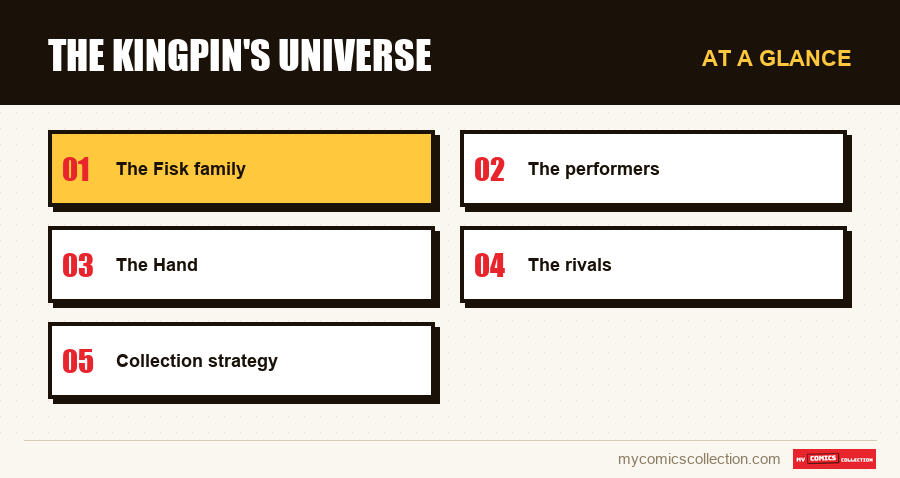
The Caïd's entourage consists of five figures: Vanessa Fisk, his wife and his only weakness; Richard Fisk, his son who became a rival; Typhoid Mary (Daredevil #254, 1988); Bulleye (Daredevil #131, 1976), his executor; and the Hand, an organization that he employs without ever completely controlling it.
The particularity of this universe is that it is based almost entirely on subordinate relationships. Where a hero surrounds himself with allies and a mad scientist with creatures, the Kingpin surrounds himself with employees, and the story draws its interest from the fact that these employees regularly stop obeying.
For the collector, these secondary characters constitute the most interesting lead in the file: several of them have their own first appearance, often at much more accessible levels than those of the Kingpin.
The Fisk family
Vanessa Fisk is the only character before whom the Caïd gives in. Its narrative function has been precise and constant since the 1960s: it makes the character vulnerable without making him sympathetic, which is a difficult ridgeline to maintain.
Successive authors have used it in the same way: as the condition upon which he renounces, temporarily, what he is. It is this possibility of withdrawal which prevents the character from being a simple obstacle.
Richard Fisk, his son, occupies the other side: that of impossible succession. He appears under several identities over the decades, including that of the Rose (Amazing Spider-Man #253, 1984), and embodies a recurring motif among crime bosses: the heir who wants to take over without having the means.
The performers
Bulleye (Daredevil #131, 1976) is the most famous and most revealing employee. The Kingpin recruits him because he never fails, and puts up with him even though he is unmanageable: an arbitration that defines the character: he accepts disorder when disorder is effective.
Its first appearance belongs to the Bronze Age and its popularity has been greatly increased by screen adaptations. It is one of the most sought-after issues of the Daredevil series today.
Typhoid Mary (Daredevil #254, 1988) is the other great creation of this entourage. A character with multiple personalities, she escapes any logic of subordination and therefore constitutes one of the rare elements that the Caïd fails to administer.
This issue remains more accessible than Daredevil #131 while carrying a significant first appearance: a configuration that this corpus regularly recommends.
The Hand
Organization of killers linked to a cult, the Hand runs through the Daredevil series since Frank Miller's run. The Caïd uses him occasionally, without ever obtaining his loyalty.
This report is instructive: it shows the limit of its power. He can buy men, not believers. Whenever the story needs an adversary beyond its control, this is the organization it turns to.
The rivals
The organized crime of this universe includes several other bosses, some of whom predate the Kingpin himself. They fulfill a specific function: to remind people that their position is not certain and that a void is immediately filled.
This is, moreover, the basis of several of his best stories: not his fight against a hero, but his fight for preserve what he has built in the face of competitors as patient as him.
Collection strategy
The recommendation is clear for this universe.
The first appearances of supporting roles offer a much better relationship than those of the main character. Daredevil #254 (Typhoid Mary) and Amazing Spider-Man #253 (the Rose) are authentic keys, less disputed than the 1967 issue, and attached to the same narrative whole.
They also have an advantage that this corpus often points out: these characters are adaptable, and each appearance on screen renews interest in their first appearance. The potential is real, without the premium already paid on major keys.
As always, condition and gradation determine value; relying on real recent sales is strongly recommended.
For the complete selection, see our key numbers of the Caïd and our collection guide.
Follow the first appearances of the entire Caïd entourage and spot your missing ones with My Comics Collection.
Discover the applicationCollecting this series?
Track what you own, what you are missing and what your collection is worth. 7 day trial.
Start my trial →Building a collection around the Kingpin: buying circles and chronological markers
Around the Kingpin, the most effective approach is to think in circles, from the closest to the most distant, rather than chasing a single issue. This method spreads your budget, avoids paying twice for the same demand and shows what is missing.
Four chronological markers
The issues cited in this file span more than twenty years, and each one matches a specific relationship with the Kingpin.
- 1967: the issue of the Kingpin's own debut, the most contested of the whole set.
- 1976: Bullseye, in Daredevil #131, a Bronze Age first appearance.
- 1984: the Rose, alias Richard Fisk, in Amazing Spider-Man #253.
- 1988: Typhoid Mary, in Daredevil #254.
Reading in the order of the relationships
Reading these last three markers in order of publication shows three ways of not obeying. Bullseye is the enforcer the Kingpin tolerates because he is effective. Richard Fisk is the heir who wants the seat without the means. Typhoid Mary, finally, escapes any logic of subordination. The Hand, for its part, runs through the Daredevil series since Frank Miller's run: it is read over time, across several issues, more than it is hunted down in a single issue.
Four buying circles
The first circle is the Kingpin. The second is the family, with Vanessa and Richard Fisk. The third gathers the enforcers, Bullseye and Typhoid Mary. The fourth is the organization, the Hand, and the rivals in organized crime. Moving circle by circle avoids spending your whole budget on the 1967 issue alone.
Points of caution
Before each purchase, check that the issue really is the first appearance you want and not a neighboring issue of the same arc. Also tell the series apart: Daredevil and Amazing Spider-Man each carry a key from this entourage, with different markets. Finally, interest in these characters rises mostly around their screen appearances: it is better to buy during a lull than on the day of an announcement.
A coherent buying order is to start with the two least contested keys, Typhoid Mary and the Rose, then aim for Bullseye, and keep the 1967 issue for last, once the rest of the set is already in place.
Frequently asked questions
Five figures: Vanessa Fisk, his wife and only weakness, Richard Fisk, his son turned rival, Typhoid Mary (Daredevil #254, 1988), Bullseye (Daredevil #131, 1976), his enforcer, and the Hand, an organization he employs without ever fully controlling it. This universe rests almost entirely on relationships of subordination.
Their first appearances offer far better value than those of the main character. Daredevil #254 (Typhoid Mary) and Amazing Spider-Man #253 (the Rose) are genuine keys, less contested than the 1967 issue. These characters are also adaptable, and each screen appearance renews interest in their first appearance.
The Kingpin recruits Bullseye because he never misses, and puts up with him even though he is unmanageable: he accepts disorder when disorder is effective. His first appearance, Daredevil #131 (1976), belongs to the Bronze Age. Boosted by screen adaptations, it is now one of the most sought-after issues of the Daredevil series.
A character with multiple personalities, she escapes any logic of subordination and is one of the few elements the Kingpin fails to manage. Her first appearance, Daredevil #254 (1988), remains more accessible than Daredevil #131 while carrying a significant first appearance.
An organization of killers tied to a cult, the Hand runs through the Daredevil series since Frank Miller's run. The Kingpin employs it occasionally without ever gaining its loyalty, which shows the limit of his power: he can buy men, not believers. It serves as an adversary that escapes his control.