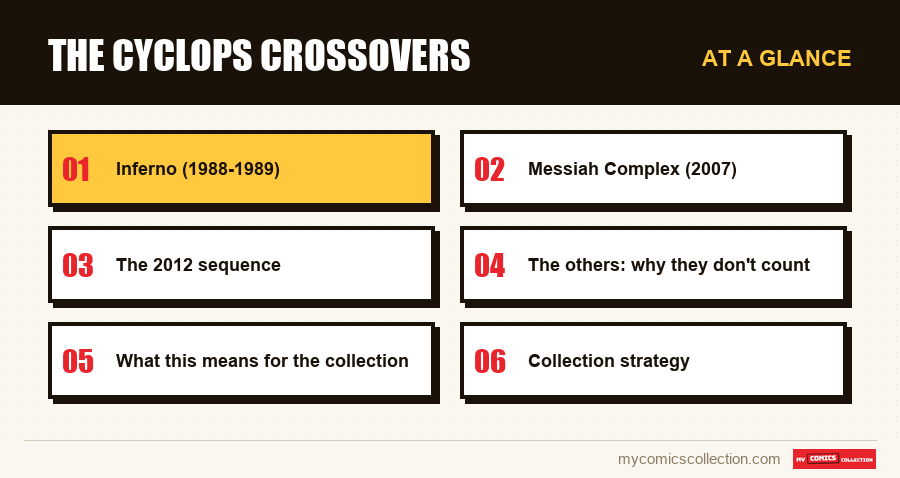
Cyclops has been through almost every major crossover in his franchise since 1963, and that's precisely the problem: a permanent presence creates no value. Only three count for his file: Inferno (1988-1989), Messiah Complex (2007) and the sequence of 2012, where it is the cause.
This file illustrates a rule that this corpus had not yet had the opportunity to pose so clearly: the value of an appearance is inversely proportional to its frequency.
A character present everywhere is not remarkable anywhere.
Participant, issue, or cause?
Before examining the events, we must make the distinction which allows us to sort: because without it, the list would be endless.
In a crossover, a character can occupy three positions.
Participant: he is present, he acts, but the event would take place without him. This is its position in the vast majority of cases.
Stake: the event concerns him, what he holds or what he risks.
Cause: the event exists because it did something.
Only the last two permanently attach a character to a crossover. Over sixty years of continuous presence, Cyclops has only held third position once.
Inferno (1988-1989)
The event that deals with the aftermath of what was done to him at the start of the decade.
There it is stake rather than participating: what is at stake concerns him directly, and the story asks him to account for previous decisions.
Extended crossover. Central numbers are searched; the tie-ins of neighboring series remain at the price of all comers while containing a real part of the story.
Messiah Complex (2007)
The event where he assumes command in degraded conditions, and where his choices involve the entire franchise.
Intermediate position: he is not the cause of the crisis, but he is the one who decides the response, and this response determines the editorial direction of the following years.
Recent and abundant period, with the usual precautions on alternative covers.
The 2012 sequence
The only event of his career of which he is the cause.
What he does triggers the story, determines its outcome, and permanently changes his place in the franchise. This is the exception that confirms all of the above.
This corpus signals the corresponding market anomaly: this event is also the one where the character displeased his audience the most. His numbers therefore remained accessible even though they constitute, objectively, the most important in his file.
To aim for in collection: the main series of the event, and the collective title numbers which immediately surround it. Recent, widely used, inexpensive.
The others: why they don't count
The character has appeared in almost every major event in his franchise since the 1980s. None is a key to his case.
The reason is mechanical, and it is worth stating: when a character is present in two hundred event numbers, none of these two hundred numbers can be distinguished. The rarity of an appearance makes its value; ubiquity cancels it out.
It's a disadvantage structural, and it does not correct itself. A character installed at the center of a franchise for sixty years will never have appearance keys, because his appearances are not events.
What this means for the collection
A practical consequence which reverses the usual approach.
On most files, we look for the numbers where the character appears. Here it goes nowhere: it appears everywhere.
The useful question is different: in which numbers he decides? The answer lies in around ten references over sixty years, and this is exactly the list that needs to be put together.
This approach has an appreciable secondary advantage: it makes the file affordable. The numbers where he decides almost all belong to recent and abundant periods.
Collection strategy
Prioritize the 2012 sequence. This is the only event he caused, and it has remained accessible for the wrong reasons.
Add Inferno tie-ins rather than the central numbers, if budget matters.
Don't try to cover crossovers where it appears. It would be an endless and uninteresting project: his presence there is not an event.
As always, condition and gradation determine value; relying on real recent sales is strongly recommended.
Find the complete selection in our key numbers and our collection guide.
Track each crossover and identify missing tie-ins with our collection management application.
Collecting this series?
Track what you own, what you are missing and what your collection is worth. 7 day trial.
Start my trial →Where to read Cyclops: five markers to get your bearings
The Cyclops crossover file becomes clear when set back into the character's timeline. Here are five markers that let you read without getting lost and collect with method.
The beginnings. Cyclops is one of the original X-Men: he appears right from X-Men #1 (September 1963), by Stan Lee and Jack Kirby. His presence has therefore been constant for sixty years, which explains the ubiquity described above: his appearances are almost never events in themselves.
The 1975 turning point. With Giant-Size X-Men #1, the team is relaunched with new members, and Cyclops becomes the group's field leader. In that role he is found at the center of the period's big stories, without every issue counting.
The 1980 drama. The Dark Phoenix saga, with Jean Grey's death in Uncanny X-Men #137, fixes for a long time what Cyclops loses and what he carries. It is a reading marker, and it explains the stake the character becomes in Inferno, a few years later.
The era of command. With Messiah Complex (2007), Cyclops takes over leadership of the franchise, and his choices determine what follows. This is the period when he decides the response to the crisis, rather than merely taking part in it.
The 2012 rupture. With Avengers vs. X-Men, this is the only time Cyclops is the cause of the event: having become host of the Phoenix Force, he slides into a tyrant's role, even killing Professor Xavier in #11. It is also, as noted above, the event least well received in his file.
To collect without scattering yourself, here are three tips:
- Set yourself a question, not a list. Ask in which issues he decides, not in which he appears.
- Do not confuse importance with rarity. A central 2012 issue is important but heavily printed, so easy to find.
- Complete with the surrounding issues. An event reads poorly without its prologues and immediate aftermath.
Keep one last point in mind: an event is a story before it is a collectible. Reading the main series of the 2012 sequence in order, with the issues that immediately surround it, gives you the context to judge for yourself which numbers deserve a place on your shelf, instead of relying only on a list of appearances.
Frequently Asked Questions
Only three: Inferno (1988-1989), Messiah Complex (2007) and the 2012 sequence, of which he is the cause. The character appears in almost every major event since the 1980s, but no other is a key of his file.
Because the value of an appearance is inversely proportional to its frequency. Present in two hundred event issues, none can stand out: ubiquity cancels rarity, and a character placed at the center of a franchise for sixty years has no appearance keys.
A participant is present but the event would unfold without him; a stake is what the event is about; a cause is the one who triggers it. Only the last two positions durably tie a character to a crossover, and Cyclops has been a cause only once in sixty years.
The 2012 sequence, where Cyclops is the cause of the event. It is also the one where the character most displeased his audience, hence recent, heavily printed and cheap issues, even though they are objectively the most important of his file.
Prioritize the 2012 sequence, add Inferno's tie-ins rather than the central issues if budget matters, and do not try to cover every crossover where he appears. The right question is: in which issues does he decide?