
The three runs that make the Caïd: Frank Miller on Daredevil (1979-1986) for the invention of the modern character, Brian Michael Bendis and Alex Maleev (2001-2006) for his version of a cornered businessman, and Chip Zdarsky (2019-2024) for his accession to political power. None of these runs bear his name: this is the character's particularity.
The Caïd never had a long series to his name. His career was built in other people's titles: first Spider-Man, then Daredevil, where he became the most worked adversary in the character's history.
For the collector, this means that “collecting the Caïd’s runs” amounts to targeting segments of Daredevil rather than a dedicated series. The good news: these segments are perfectly demarcated and complement each other without difficulty.
Top 1: Frank Miller (Daredevil #170-191 + Born Again #227-233, 1981-1986)
Writer/designer: Frank Miller | Inker: Klaus Janson | Drawing on Born Again: David Mazzucchelli
This is the founding run, and we must be clear: the Caïd as we know him did not exist before him. Miller picks him up from Spider-Man, where he was just another crime boss, and makes a tragic figure: a man of superior intelligence, endowed with a code, capable of real affection, and whose respectability is true power.
“Born Again” constitutes the absolute peak. The Caïd obtains the secret identity of his adversary and, rather than killing him, undertakes to take your life apart piece by piece: his accounts, his job, his accommodation, his reputation. It's a demonstration of what an opponent can do when they don't need to fight.
Key numbers: #170 (entrance of the Kingpin to Daredevil), #181, #227 (opening of Born Again), #233 (conclusion).
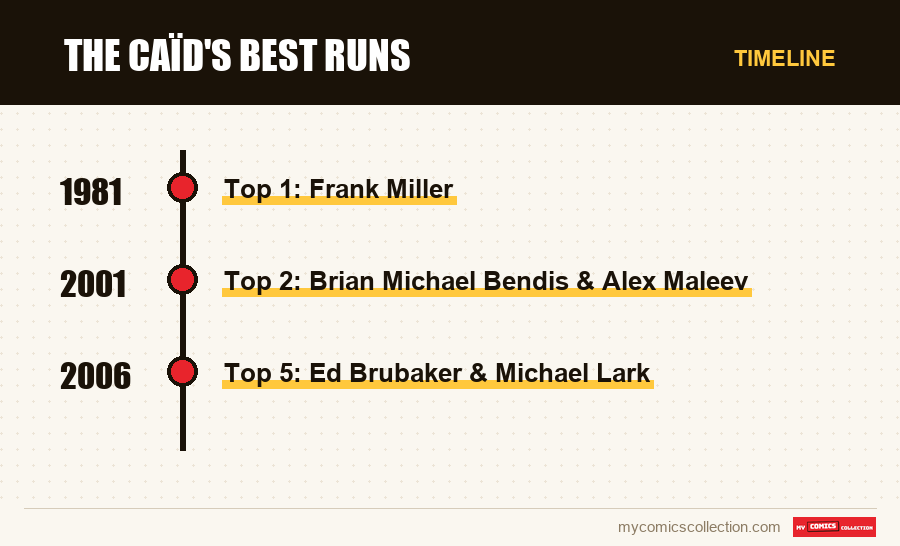
Top 2: Brian Michael Bendis & Alex Maleev (Daredevil vol. 2 #26-81, 2001-2006)
Screenwriter: Brian Michael Bendis | Designer: Alex Maleev
Bendis takes the character where Miller left off and applies continued pressure. The Kingpin is there overturned, exiled, forced to reconquer what he had built, and the run draws its intensity from what a man accustomed to control becomes when he no longer controls anything.
Maleev composes photo-referenced plates of thick darkness which are particularly suitable for this character: the mass, the costume, the impassive face gain a physical presence that conventional drawing poorly conveys.
Key numbers: #26 (start of run), #32, #81 (conclusion).
Collecting this series?
Track what you own, what you are missing and what your collection is worth. 7 day trial.
Start my trial →Top 3: Chip Zdarsky (Daredevil vol. 6, 2019-2024)
Screenwriter: Chip Zdarsky | Designers: Marco Checchetto, Rafael De Latorre
Zdarsky pushes the logic of the character to its conclusion: if the real power of the Kingpin is respectability, then its logical destination is the election. The run installs him at New York City Hall and methodically explores what becomes of a masked vigilante facing an adversary who holds legal legitimacy.
The idea is excellent and closes a circle opened in 1967: the character had been designed as a criminal who resembles a notable person; he ends up notable for good.
Key numbers: the numbers of the “Devil's Reign” arc and its tie-ins.
Top 4: Charles Soule (Daredevil vol. 5, 2016-2018)
Screenwriter: Charles Soule | Designers: Ron Garney, Goran Sudžuka
Soule is a lawyer by training, and it shows: his run gives an unusual place to legal mechanisms, terrain on which the Kingpin is much more dangerous than in a physical confrontation. It is this run that begins his shift towards political power.
Top 5: Ed Brubaker & Michael Lark (Daredevil vol. 2 #82-119, 2006-2009)
Screenwriter: Ed Brubaker | Designer: Michael Lark
Brubaker takes over immediately from Bendis without a break in tone, and gives the Kingpin some of his best sequences in a weak position. A run that is unfairly less cited than its neighbors, and clearly more accessible in collection for this reason.
How to collect these runs
A practical remark is in order. These five segments cover forty years but represent only one fraction from the Daredevil series. Seeking to own the entire series is an expensive and largely unnecessary endeavor for anyone interested in The Kingpin.
The effective method is to target the terminals of each run (first and last number, plus the two or three central numbers) then to be completed as a collection for reading. You get the essentials for a fraction of the price.
The “Born Again” collections are reissued regularly and remain the best reading buy of the lot.
For number-by-number selection, see our key numbers of the Caïd and our collection guide.
Track each run and identify missing numbers with our collection management application.
Frequently asked questions
Frank Miller on Daredevil (1979-1986), who invents the modern character, Brian Michael Bendis and Alex Maleev (2001-2006), for his cornered businessman side, and Chip Zdarsky (2019-2024), for his rise to political power.
He never held a long series under his own name. His career was built in other people's titles, first Spider-Man then Daredevil, where he became the most carefully developed adversary of the character.
The Kingpin obtains Daredevil's secret identity and, rather than kill him, dismantles his life piece by piece: accounts, job, home, reputation. The key issues of Miller's run are #170, #181, #227 (the opening of Born Again) and #233 (the conclusion).
He pushes the character's logic to its end: if his real power is respectability, his destination is elected office. The run installs him at New York's city hall, with the "Devil's Reign" arc and its tie-ins.
Target the bookends of each run (first and last issue, plus two or three central issues) and fill in with a collected edition for reading. The "Born Again" collections are regularly reissued, and Brubaker and Lark's run (#82-119) is less cited and therefore more accessible.