The runs that make Storm: Chris Claremont on Uncanny X-Men (1975-1991), sixteen years building everything; Greg Pak on his first continuing series (2014); Reginald Hudlin on Black Panther (2005-2008) for its Wakandan period; and the run of Jason Aaron (2011-2014) where she runs a school. Like many team-up characters, she didn't get a series to her name until very late.
Storm is a common case among team characters: she has existed since 1975 and has only obtained a series continues in his name only in 2014, thirty-nine years later. Everything that defines it is therefore constructed in the collective titles.
For the collector, this means that his best stories are found in segments of Uncanny X-Men, a long-running series in which most issues have no particular interest. Knowing where to cut is the main part of the job here.
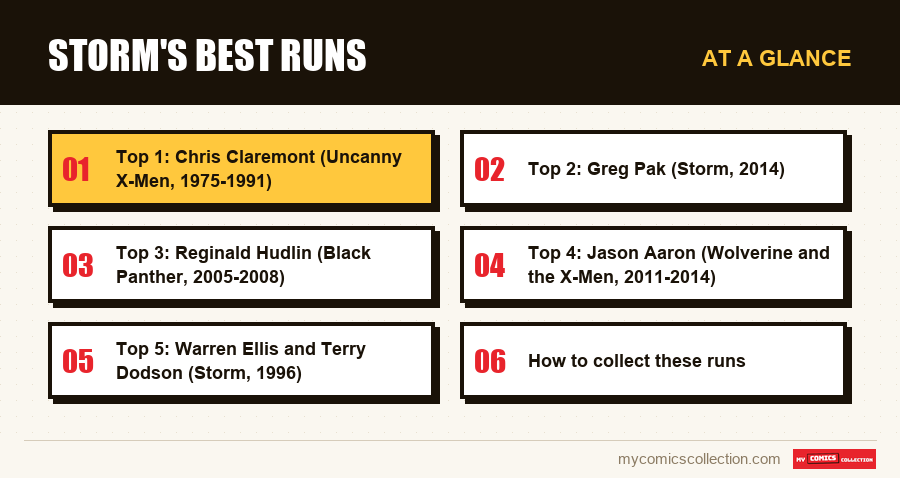
Top 1: Chris Claremont (Uncanny X-Men, 1975-1991)
Screenwriter: Chris Claremont | Designers: Dave Cockrum, John Byrne, Paul Smith, John Romita Jr., Marc Silvestri
Sixteen years on the same title, and everything that makes the character. Claremont takes an African goddess created for international distribution reasons and patiently makes her the most complex figure on his team.
The decisive sequence runs from 1983 to 1986: radical visual overhaul, taking command, loss of powers, then victory in a duel without powers. No other run in the catalog has so much taken apart and then rebuilt a character.
Segments to target: #169-173 (Morlocks and visual overhaul), #185-186 (loss of powers and “Life-Death”), #198-201 (the duel).
Top 2: Greg Pak (Storm, 2014)
Screenwriter: Greg Pak | Designers: Victor Ibáñez, Al Barrionuevo
The first series continues in the name of the character, thirty-nine years after its creation. The run adopts a clear bias: Storm acts alone, outside of any team structure, and intervenes on concrete situations rather than on cosmic threats.
This choice is the right one. A character whose particularity is to have been worshiped as a divinity functions better in front of people he helps than within a group where his singularity is diluted.
Short, recent, abundant series: it is one of the best reading purchases in the file.
Top 3: Reginald Hudlin (Black Panther, 2005-2008)
Screenwriter: Reginald Hudlin
The character's Wakandan period, with marriage then her installation as queen. Storm leaves the mutant frame for a frame policy, which suits him remarkably well.
This run raises a question that this body of work finds interesting: does a team character benefit from being moved to another franchise? Here the answer is yes, because this displacement gives it a own function: to govern: which she had nowhere else.
Top 4: Jason Aaron (Wolverine and the X-Men, 2011-2014)
Screenwriter: Jason Aaron
Storm runs a school there, a role that naturally extends her years of command. The run is lighter in tone than its neighbors, and offers some of its best dialogue scenes.
Recent period, comfortable prints: to collect in collections without hesitation.
Top 5: Warren Ellis and Terry Dodson (Storm, 1996)
Screenwriter: Warren Ellis | Designer: Terry Dodson
A four-issue miniseries, often forgotten, and yet the first serious attempt to carry the character alone. It has the advantage specific to limited series: it can be completed in one search, for a paltry budget.
Collecting this series?
Track what you own, what you are missing and what your collection is worth. 7 day trial.
Start my trial →How to collect these runs
A decisive practical remark. The Claremont run has several hundred issues, the vast majority of which bring nothing particular to Storm. Seeking to own it outright is an expensive and largely pointless endeavor.
The effective method is to target the three segments indicated above, around fifteen issues in total, and to complete the rest in collections. You get the essentials for a fraction of the price.
The short series (1996, 2014) complete each other without difficulty and constitute, for a modest budget, sets that few collectors own.
For number-by-number selection, see our key numbers and our collection guide.
Track each run and identify missing numbers with our collection management application.
Origin landmarks to know before choosing a run
The ranking above starts in the middle of the Claremont period, but Storm's career begins a few issues earlier. Two origin landmarks and one modern landmark let you place each run in the character's trajectory and avoid searching in the wrong place.
Giant-Size X-Men #1 (May 1975). Titled "Second Genesis!", written by Len Wein and drawn by Dave Cockrum, this issue marks the first appearance of Ororo Munroe: Storm joins the new team there. It is the absolute starting point, before Chris Claremont's run. Even though this article concentrates on what built the character afterward, it is the issue to know to place Storm's birth in the team.
Uncanny X-Men #94 (August 1975). The first issue of the series written by Chris Claremont, with Dave Cockrum on art. This is the start of the sixteen years described above: everything that makes Storm a complex character is built from this moment, title after title.
Uncanny X-Men #201 (January 1986). Titled "Duel", with Rick Leonardi on art, this issue closes the duel sequence cited in the 198-201 segment. It also marks the appearance of Nathan Summers as a baby, which makes it sought for a reason other than Storm. The two buying motives overlap, which is useful to know before comparing copies.
Storm #1 (September 2014). Written by Greg Pak and drawn by Victor Ibáñez, this is the first issue of the first continuing series in the character's name. It comes almost forty years after Giant-Size X-Men #1, which illustrates the opening observation: Storm existed for a long time without her own series.
A simple reading order
- Origin: Giant-Size X-Men #1, then Uncanny X-Men #94 to enter the Claremont run.
- Heart of the run: the three segments of the ranking, about fifteen issues, without trying to read everything.
- Other settings: Black Panther (2005-2008) for the Wakandan period, then Wolverine and the X-Men for the school.
- Series in her name: the 1996 mini-series, then the 2014 series, which are easy to complete.
Cover date and release date
The landmarks above carry their cover date, which comes a few weeks before or after the actual release: Giant-Size X-Men #1 is dated May 1975 for an April release, and Uncanny X-Men #94 dated August 1975 for a June release. When you compare listings, rely on the printed cover date to identify the right issue.
Frequently asked questions
Chris Claremont's on Uncanny X-Men (1975-1991), sixteen years that build the whole character. The decisive sequence runs from 1983 to 1986: visual overhaul, taking command, loss of powers, then winning a duel without powers.
Issues #169-173 (Morlocks and visual overhaul), #185-186 (loss of powers and "Life-Death") and #198-201 (the duel). That is about fifteen issues, with the rest of the run completed in collected editions.
In 2014, with the first continuing series in her name, written by Greg Pak, thirty-nine years after her creation in 1975. The run shows her acting alone, outside any team structure.
Reginald Hudlin's on Black Panther (2005-2008), the Wakandan period with the marriage and then her installation as queen. This move gives her a function of her own, governing, which she had nowhere else.
No, it has several hundred issues, the vast majority of which add nothing in particular about Storm. The efficient method is to target the three indicated segments and complete the rest in collected editions.