Crossovers that matter to Malicia: Mutant Massacre (1986), Fall of the Mutants (1988) and the Australian period that followed, X-Tinction Agenda (1990), Age of Apocalypse (1995) and Avengers vs. X-Men (2012). The selection criterion: those where its conscience stolen or her status as a former adversary are at stake.
Rogue has been through every major mutant event since 1983, which is hundreds of issues. The difficulty is not finding them, it's knowing which ones really do something to him.
This classification therefore applies a single criterion: does the event bring into play what distinguished: his double consciousness, his past as an adversary, his inability to make contact? The others are team numbers where it appears.
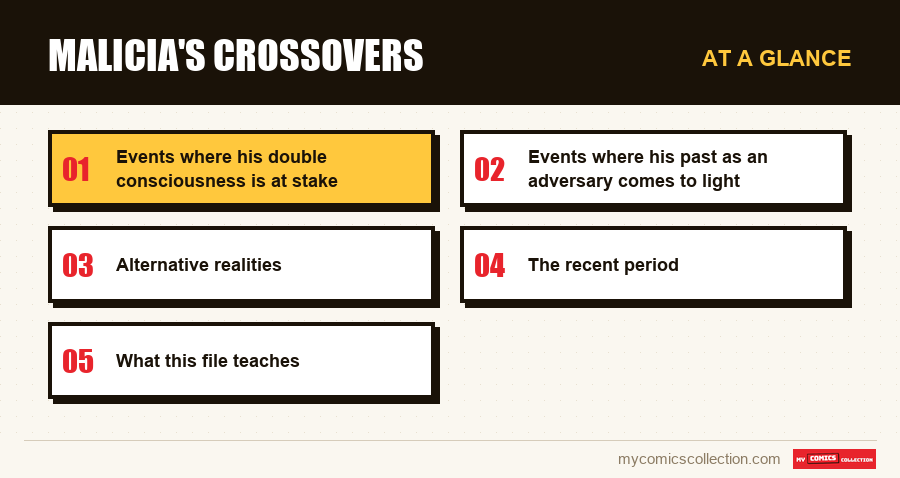
Events where his double consciousness is at stake
Fall of the Mutants (1988) and the Australian period
This is the most important ensemble for this character, and the most misidentified.
The team publicly disappears and settles clandestinely in Australia. For Malicia, this period is decisive: she directly faces the conscience stolen that she has been carrying since 1981, and the question that had lingered for seven years finally came to light.
Collection point: these numbers are almost never presented as character keys. They belong to a period of Uncanny X-Men that the market treats as commonplace, even though it contains the resolution of its founding problem.
Uncanny X-Men #266-269 (1990)
Technically an arc rather than a crossover, but inseparable from the above: it is the conclusion of the affair begun in 1981.
⚠️ #266 is the most expensive number in this entire file: for a first appearance that is not his. The next three, which contain the resolution, remain very accessible.
Events where his past as an adversary comes to light
Mutant Massacre (1986)
The Morlock Massacre. Malicia takes part in the rescue operations, and the event tests the trust the team has placed in her for three years.
Crossover extended across several titles. Uncanny X-Men issues are wanted; tie-ins from neighboring series remain affordable and contain a substantial part of the story.
X-Tinction Agenda (1990)
A slave nation captures part of the team. Event of 1990, therefore in the middle of a period of overproduction: considerable print runs, abundant copies, value almost entirely decided by the gradation.
Excellent at reading, mediocre at placement. To collect in collection.
Alternative realities
Age of Apocalypse (1995)
A continuity where the mutant story has diverged, and where Malicia occupies a radically different position.
This type of event is of specific collecting interest: it produces alternative versions of well-known characters, some of whom later joined the main continuity. These beginnings of variants are often misidentified in announcements.
The crossover suspended all regular series for its duration, making it a cohesive block: it's collected as a set, not a selection.
The recent period
Avengers vs. X-Men (2012)
The conflict between the publisher's two major teams. For Malicia, it opens directly onto his time in the mixed team: the best trip of his modern career.
The Krakoa era (as of 2019)
The remaking of the mutant franchise into a sovereign nation. Malicia held notable positions there, and the period produced a considerable amount of numbers.
⚠️ Watch out for alternative covers, very numerous over these years, with significant differences in value in both directions. Identify the variant before purchasing.
What this file teaches
An observation of method, valid beyond this character.
Among a team member, the majority of crossovers are figures: the character is there, he acts, nothing happens to him. These numbers have no value of their own and are paid like ordinary numbers: which they are.
The rare events that matter are those that affect particularity of the character. At Malicia, it's the Australian period of the late 1980s, and it's precisely the one that the market ignores.
The rule of thumb: before buying a tie-in, ask yourself what the event does to the character. If the answer is “nothing specific,” it’s a team number.
As always, condition and gradation determine value; relying on real recent sales is strongly recommended.
Find the complete selection in our key numbers and our tier list of key issues.
Track each crossover and identify missing tie-ins with our collection management application.
Collecting this series?
Track what you own, what you are missing and what your collection is worth. 7 day trial.
Start my trial →A timeline for following Rogue event by event
Rogue has been through the major mutant events since 1983. To avoid getting lost among hundreds of issues, the simplest approach is to follow the timeline of events and ask, at each stage, what happens to the things that set her apart: her double consciousness, her past as an adversary and her inability to touch.
1981 to 1983: the origin of the problem
The stolen consciousness she carries dates from 1981, and her arrival in the mutant team dates from 1983. The whole file hangs on that gap: a question raised very early, which will take years to be addressed head-on.
1986: Mutant Massacre
The first test of the trust the team has given her for three years. She takes part in the rescue operations after the massacre of the Morlocks. The Uncanny X-Men issues are the most sought after; the tie-ins from neighboring series remain affordable and carry a substantial part of the story.
1988: Fall of the Mutants and Australia
This is the turning point. The team disappears from public view and settles secretly in Australia, and the question that had been dragging on for seven years is finally faced head-on. These issues are almost always sold as run-of-the-mill: it is the most advantageous segment of the file.
1990: X-Tinction Agenda, then Uncanny X-Men #266-269
X-Tinction Agenda is an excellent story to read but a poor placement: take it as a collected edition. The #266-269 arc concludes the 1981 affair; buy the last three issues for the resolution, and #266 only if you accept paying for a first appearance that is not hers.
1995: Age of Apocalypse
All the regular series were suspended for the duration of the event: it is a coherent block, to be collected as a set rather than piece by piece. The variant debuts it contains are often poorly identified in listings.
2012 and after: Avengers vs X-Men, then Krakoa
The clash between the two major teams leads to her move to a mixed team, the best shift of her modern career. The Krakoa era, from 2019, produced a huge number of issues with many alternate covers: always identify the variant before buying.
A method in three reflexes
- Look first for the issues where something happens to her, not those where she merely appears.
- Prefer affordable tie-ins to flagship issues when the story is just as present there.
- For events from 1990 onward, remember that overproduction makes grading decisive.
Frequently asked questions
Mutant Massacre (1986), Fall of the Mutants (1988) and the Australian period, X-Tinction Agenda (1990), Age of Apocalypse (1995) and Avengers vs X-Men (2012). The criterion is simple: the event must put her stolen consciousness or her past as an adversary at stake.
Fall of the Mutants (1988) and the Australian period that follows. Rogue directly confronts the stolen consciousness she has carried since 1981, and the market treats these issues as run-of-the-mill.
Technically it is an arc, but it concludes the affair that began in 1981. #266 is the most expensive issue in the file, for a first appearance that is not hers; the next three, which contain the resolution, remain very accessible.
Rather as a collected edition. A 1990 event, it dates from the overproduction period: huge print runs, abundant copies and a value almost entirely decided by grading.
Before buying a tie-in, ask yourself what the event does to the character. If the answer is "nothing specific", it is a team issue, to be paid for like an ordinary one.