
The runs that make Malicia: Chris Claremont on Uncanny X-Men (1981-1991) for its creation and change; Rick Remender on Uncanny Avengers (2012-2014), where she finally leaves the mutant orbit; Kelly Thompson (2018) for the couple; And Robert Rodi (2004) for its first continuing series. Twenty-three years passed between its creation and its first solo title.
Like many characters born in a team, Malicia was built in fragments: a few issues here, an arc there, over forty years and around ten titles.
This ranking isolates the segments that really matter: those where it is the subject, and not one presence among others.
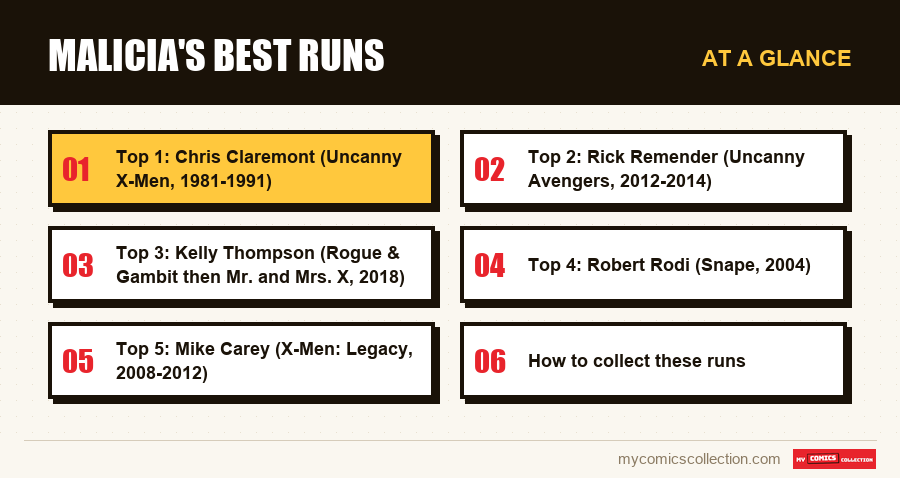
Top 1: Chris Claremont (Uncanny X-Men, 1981-1991)
Screenwriter: Chris Claremont | Designers: Paul Smith, John Romita Jr., Marc Silvestri, Jim Lee
Claremont created the character in 1981, switched him to the heroes in 1983, and then spent eight years exploring the consequence of this shift: a team that is suspicious, a stolen conscience that refuses to fade, a power that prohibits all contact.
The decisive point of this run, and what puts him in the lead: he does not solves never these problems. The character lives with it, which is rarer than it seems in a catalog that prefers solutions.
Segments to target: Avengers Annual #10 (1981), Uncanny X-Men #171-173 (the integration), #266-269 (Gambit and the settlement of the Danvers affair).
Top 2: Rick Remender (Uncanny Avengers, 2012-2014)
Screenwriter: Rick Remender | Designers: John Cassaday, Daniel Acuna
Malicia joins a mixed team bringing together mutants and Avengers, and it is the first time in thirty years that she has operated outside the exclusively mutant orbit.
The move succeeds for a specific reason: in a team of X-Men, his past as an adversary is an old story that everyone knows. In a mixed team, he becomes a subject, and the character finds a friction that he had lost.
This corpus retains a useful principle from this run: an established character often benefits from changing teams rather than changing powers.
Top 3: Kelly Thompson (Rogue & Gambit then Mr. and Mrs. X, 2018)
Screenwriter: Kelly Thompson
Two consecutive short series, which take the couple as their subject and treat them with a seriousness that they had never received: including the question, long evaded, of what it means to have a relationship with someone you cannot touch.
These series are recent, short and abundant: they complement each other entirely for a paltry budget. The best buy reading file.
Top 4: Robert Rodi (Snape, 2004)
Screenwriter: Robert Rodi
The first series continues in the name of the character, twenty-three years after its creation. It is especially worth as editorial milestone: the moment when a team character finally gets a title.
Twelve numbers, easy to collect, and rarely searched for.
Top 5: Mike Carey (X-Men: Legacy, 2008-2012)
Screenwriter: Mike Carey
A run that gives an unusual place to the psychological consequences of the power of absorption: accumulated consciousnesses, what they do to someone over time.
Recent period, comfortable print runs, little demand: excellent value for those buying in booklets.
Collecting this series?
Track what you own, what you are missing and what your collection is worth. 7 day trial.
Start my trial →How to collect these runs
A particularity makes this file simpler than average: the segments that count are short.
Unlike characters whose interest is scattered across hundreds of issues, Malicia focuses on a few well-delineated handfuls: the 1981 annual, three issues in 1983, four in 1990, and then modern short series.
Practical consequence: a representative collection is constituted with a twenty booklets, which is not much. The 2018 and 2004 series complete each other in full without difficulty.
The Claremont run, on the other hand, cannot be collected in its entirety: target the segments and read the rest in collections.
For number-by-number selection, see our key numbers and our collection guide.
Track each run and identify missing numbers with our collection management application.
Rogue's timeline and recommended reading order
The character was built in fragments, and the timeline shows why reading by run works better than reading linearly:
- 1981: created by Chris Claremont in Avengers Annual #10.
- 1983: switches to the heroes in Uncanny X-Men #171 to #173.
- 1990: Uncanny X-Men #266 to #269, with Gambit.
- 2004: first ongoing series in her name, by Robert Rodi, twenty-three years after her creation.
- 2008 to 2012: X-Men: Legacy, by Mike Carey.
- 2012 to 2014: Uncanny Avengers, by Rick Remender.
- 2018: Rogue & Gambit then Mr. and Mrs. X, by Kelly Thompson.
Two reading orders hold up depending on what you want. To understand the character, follow the chronology: the 1981 annual, the 1983 integration, then the 1990 storyline. For immediate reading pleasure, start instead with Kelly Thompson's recent series: short, plentiful and centered on the couple, they can be read without knowing the character's past.
Each run answers a different question. Claremont lays the foundations: a stolen consciousness, a power that forbids all contact, a team that distrusts her. Mike Carey digs into the long-term psychological consequences of absorption. Rick Remender puts her in a mixed team, where her past as an adversary becomes an issue again. Kelly Thompson finally treats the relationship with Gambit head-on. Choosing a run therefore means choosing a question.
For the collector, the math is simple. The 1981 annual (1 issue), the 1983 issues (3) and the 1990 ones (4) make eight issues; the 2004 series adds twelve. That gives about twenty issues to cover the essentials of the character, even before adding the modern series, which are plentiful and complete.
One last tip: don't buy Claremont's run as a whole. It spans ten years and several hundred issues in which she is not the subject; target the segments listed above and read the rest in collected editions.
Frequently asked questions
Chris Claremont's on Uncanny X-Men (1981-1991), at the top of the ranking. He creates the character in 1981, has her switch to the heroes in 1983, then spends eight years exploring the consequences: a team that distrusts her, a stolen consciousness, a power that forbids all contact. He never solves these problems, which is rarer than it seems.
Avengers Annual #10 (1981), Uncanny X-Men #171 to #173 (the integration) and #266 to #269 (Gambit and the settling of the Danvers affair). The full run isn't worth collecting: target these segments and read the rest in collected editions.
In 2004, with Robert Rodi's series, twenty-three years after her creation in 1981. It is the first ongoing series in her name, an editorial milestone. It runs twelve issues, easy to assemble and rarely sought after.
About twenty issues, which is few. The segments that matter are short: the 1981 annual, three issues in 1983, four in 1990, then short modern series. The 2018 and 2004 series are easy to complete in full.
Rick Remender (Uncanny Avengers, 2012-2014) places her in a mixed team, outside the exclusively mutant orbit for the first time in thirty years. Kelly Thompson (2018) devotes two short series to the Rogue and Gambit couple. Mike Carey (X-Men: Legacy, 2008-2012) explores the psychological consequences of the absorption power.