Carnage crossovers: Maximum Carnage (1993), fourteen episodes spread over five series: the event that made the character; Absolute Carnage (2019), which reinstated it after two decades of erasure; and the largely forgotten sequences from the late 1990s.
This file is the only one in this corpus where a crossover counts more than the first appearance: or at least, where it matters as much.
It also poses a very particular collection problem: how to approach an event whose fourteen parts are scattered across five different titles?
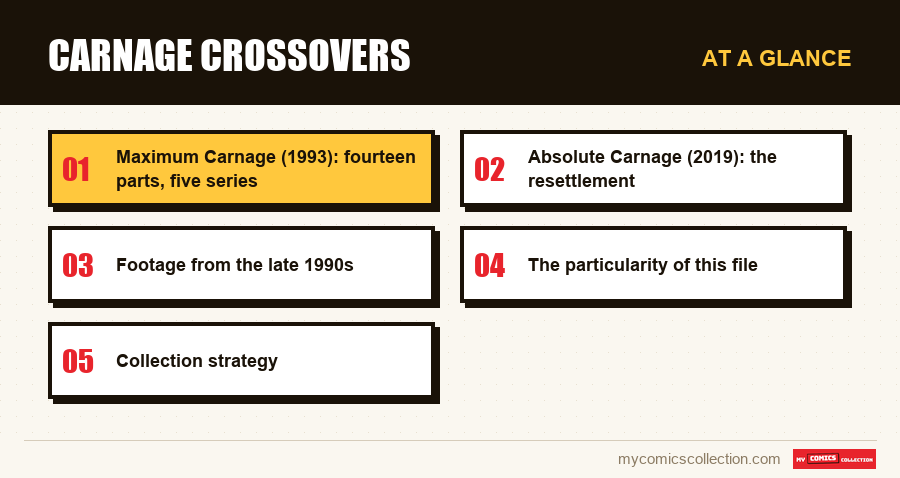
Maximum Carnage (1993): fourteen parts, five series
The event which definitively establishes the character, one year after his introduction.
Its structure is unusual: the story moves from one series to another over the episodes, without any one carrying it entirely. A reader who followed a single title only obtained one fragment out of five.
This corpus indicates what this formula implied at the time: it required the purchase of five series over four months. That was the editorial goal, and it worked.
The collection problem it poses
Thirty years later, this dispersion produces a curious situation.
Taken in isolation, none of these fourteen numbers has any particular value: they are ordinary numbers from widely printed series. Together, they form a set that collectors really want.
In other words, the value is in completeness, not in numbers. This is the opposite of the usual market logic, where a key number is worth in itself.
Practical consequence: building the set number by number costs very little, but requires patience. Buying it ready-made costs significantly more: you pay for the assembly work, not the booklets.
Absolute Carnage (2019): the resettlement
After a long period of erasure, the character returns to the center of an event constructed for him.
The approach is explicit: take a character from the 1990s and reintroduce him to a readership who had not known him.
More readable structure than that of 1993 (a main series, supplements) which makes the collection significantly simpler.
⚠️ Recent and very busy period, with a large number of alternative covers. This is the main point of vigilance in this segment: the price differences between variants are considerable and not always justified.
Footage from the late 1990s
Between the two major events, the character appears regularly in sequences that no one mentions anymore.
They belong to an unloved period in the catalog, and are at the lowest price.
Their interest is real for those who want to understand why the character has faded: these stories use the same formula without renewing it, and the wear and tear is visible.
The particularity of this file
An observation that explains its behavior on the market.
Unlike most of the characters covered here, Carnage has no structural value: nothing in the editorial architecture depends on it, and it disappeared for almost twenty years without this causing any problem.
Its demand therefore rests almost entirely on its exploitation on screen and on the nostalgia of a specific generation of readers.
This corpus draws a direct consequence from it, and it is frank: this file is cyclic. It goes up when the character is visible, it goes down when it is no longer visible, and it does not have a floor guaranteed by its place in the catalog.
This is exactly the opposite of cases where a character has become essential to the functioning of his franchise, and that does not call for the same purchasing strategy.
Collection strategy
Build Maximum Carnage number by number. The fourteen parts can be found separately for next to nothing. It's the best deal on the case, and it just takes time.
Buy outside visibility period. Since demand is cyclical, the timing of purchase really matters here: unlike cases driven by a structural position.
On 2019, stick to the main series. Complements and variations multiply the lines without adding anything to the story.
Don't overlook the footage from the late 1990s. They will not increase in value, but they cost the price of paper and document the character's trajectory.
As always, condition and gradation determine value; relying on real recent sales is strongly recommended.
Find the complete selection in our key numbers and our collection guide.
Track each crossover and identify missing episodes with our collection management application.
Collecting this series?
Track what you own, what you are missing and what your collection is worth. 7 day trial.
Start my trial →The Maximum Carnage reading order, part by part
The main obstacle to assembling Maximum Carnage is knowing which issue to pick up and when. The fourteen parts are spread over five titles, and the reading alternates from one series to another. Here is the verified order, to keep in front of you during the hunt.
- Spider-Man Unlimited #1 (opening)
- Web of Spider-Man #101
- Amazing Spider-Man #378
- Spider-Man #35
- Spectacular Spider-Man #201
- Web of Spider-Man #102
- Amazing Spider-Man #379
- Spider-Man #36
- Spectacular Spider-Man #202
- Web of Spider-Man #103
- Amazing Spider-Man #380
- Spider-Man #37
- Spectacular Spider-Man #203
- Spider-Man Unlimited #2 (conclusion)
What this order reveals for the collection
The two issues of Spider-Man Unlimited frame the event: the first opens it, the second closes it. In between, four titles take turns in a regular cycle, three issues each. That gives a simple grid: three issues of Web of Spider-Man (#101 to #103), three of Amazing Spider-Man (#378 to #380), three of Spider-Man (#35 to #37) and three of Spectacular Spider-Man (#201 to #203). Once you have this grid in mind, spotting what is missing becomes immediate.
Reading it in one go
The order also serves for reading the story. A reader who follows the parts in sequence finds a continuous narrative: Cletus Kasady's escape, the formation of Carnage's family, Spider-Man's forced alliance with Venom and Black Cat, then the final confrontation. Reading a single title, by contrast, gives only a fragment, which explains why individual issues have no value of their own.
Points to watch during the hunt
- Take the parts under the numbering of their original series: the four titles carry very different numbers (from #35 to #380), and a mix-up happens quickly.
- Do not be fooled by a "Maximum Carnage" lot: check that all fourteen references are included, including the two Spider-Man Unlimited issues, which are often forgotten.
- For Absolute Carnage (2019), stick to the main series: the tie-ins and the many alternate covers multiply references without adding anything to the story.
- With massive print runs in 1993, favor condition over scarcity: a fresh copy is easy to find.
With this list, the collection becomes a clear project: fourteen references to tick off, buyable separately for almost nothing, whose value appears precisely when the set is assembled.
Frequently asked questions
Maximum Carnage has fourteen parts spread over five series, in 1993. The story moves from one title to another from episode to episode, with none of them carrying it entirely.
Taken alone, they are ordinary issues of heavily printed series. The value lies in completeness, not in the issues: collectors look for the assembled set.
Issue by issue is very cheap but takes patience. Buying it ready-made costs noticeably more, because you pay for the work of assembling it rather than for the issues.
The 2019 event reinstalls the character and its structure is clearer, with a main series and tie-ins. It is a recent, heavily printed period with many alternate covers whose price gaps are not always justified.
No, it is cyclical. Its demand rests almost entirely on screen exploitation and on the nostalgia of one generation of readers. It rises when the character is visible and falls when it is not, hence the interest in buying outside visibility periods.