Apocalypse's climactic crossover is Age of Apocalypse (1995): an event that replaced the entire mutant series for four months. Its collection feature is unique: its key numbers are first appearances of alternative versions characters that already existed.
This is a category that the market took a long time to know how to deal with, and on which it remains inconsistent.
It is worth understanding before purchasing, as it produces considerable price differences between very similar numbers.
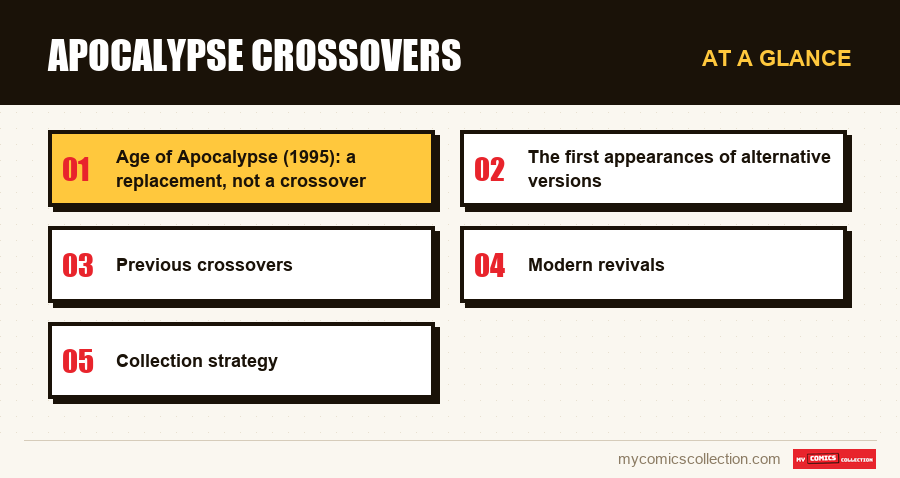
Age of Apocalypse (1995): a replacement, not a crossover
The event is not added to the current series: it replaces. For four months, the mutant titles are interrupted and give way to series with other names, in a world where the character has won.
This corpus highlights what is unusual about this formula. A regular crossover asks the reader to buy more; he asks him to buy something else, without the possibility of continuing to follow his usual series.
This is a considerable editorial challenge, and it explains the place that the event still occupies thirty years later.
What this does for a collector
An atypical structure: around fifteen limited series launched simultaneously, each with its own first issue.
A typical event produces one or two sought-after numbers. This produces around fifteen: all “number 1s”, all from the same month.
The first appearances of alternative versions
This is the central feature of this file, and it requires an explanation.
The event series introduce different versions of existing characters: same names, other backgrounds, other appearances. Some of these versions were later joins the main continuity and remained there.
This creates a hybrid category: a number that is not the first appearance of a character, but the first appearance of a version become independent.
The market treats this category unequally. When the alternative version lasted, its first issue was valued; when it remains confined to the event, it is not.
The useful rule is therefore: what makes the value here is not the appearance, it is the survival. A version that left the event to settle elsewhere has a key; the others only have numbers.
To aim for in collection
- The first issues of the series in which a character then moved into the main continuity.
- The opening and closing numbers of the event, the most sought after of the set.
- The limited series that remained without continuation: at the price of all comers, and they contain the essence of the story.
Previous crossovers
Before 1995, the character goes through several events in his franchise, generally in the position of a distant adversary.
These numbers belong to the second half of the 1980s, a well-preserved period: the supply in good condition is abundant, and only the high grade retains any value.
None constitute a key to his file, with the exception of his first appearances: which are in a secondary title of the franchise rather than in the main series.
Modern revivals
The 1995 event has seen several sequels and rereadings, at different times.
They all belong to very limited periods and have no value of their own. Their interest is to document something that this corpus finds remarkable: an alternative universe designed for four months became a permanent decoration of the catalog.
This is the sign of a rare editorial success, and it explains the lasting strength of this file.
Collecting this series?
Track what you own, what you are missing and what your collection is worth. 7 day trial.
Start my trial →Collection strategy
Distinguish the fifteen “number 1s”. They look the same, they're from the same month, and their prices differ wildly depending on whether an alternate version has survived or not. Check before buying.
Prioritize the opening and closing of the event rather than the intermediate series.
Buy non-sequel series at the price of the paper. They contain the story, they will not increase in value, and that is fine.
Only buy very high grade. 1995 belongs to the overproduction regime: the supply in new condition is abundant, and only the higher grades stand out. ⚠️ The determining defects are of origin (cutting, centering, stapling) and not of use.
As always, condition and gradation determine value; relying on real recent sales is strongly recommended.
Find the complete selection in our key numbers of Revelation and our reading guide.
Follow each series of the event and identify missing numbers with our collection management application.
Reading order and landmarks to find your way
Age of Apocalypse can feel confusing because it is read across several series at once. A few landmarks are enough to put it back in order, whether you want to read it or complete it as a collection.
The starting point: a broken timeline
The event stems from Legion Quest. Legion, Charles Xavier's son, travels back in time to eliminate his father's enemies. In trying to kill Magneto, he causes the death of Xavier, who sacrifices himself to save him. Magneto then gives up his hostility toward humans and founds the X-Men of that reality, while Apocalypse takes over. The character Bishop tries to repair the timeline.
One opening, one conclusion, series in between
The story opens with X-Men: Alpha #1 and closes with X-Men Omega #1. In between, the limited series advance in rotation, one issue from each in turn. Chapter-by-chapter collected editions thus group about fifteen issues from different titles.
The main titles to know:
- Amazing X-Men, Astonishing X-Men and Factor-X, which follow the different camps of the alternate reality.
- Gambit and the X-Ternals, Generation Next and X-Calibre, centered on small teams.
- Weapon X and X-Man, the latter of which continued after the event.
- Age of Apocalypse: The Chosen, a standalone issue that completes the set.
How to read without getting lost
Read by chapters rather than series by series: the plot moves from title to title, and an isolated issue loses part of its meaning. Start with Alpha, finish with Omega, and read the in-between series in publication order rather than title by title.
How to complete a set without duplicates
Each series restarts at issue #1, which multiplies the risk of confusion: an "issue #2" can belong to six different titles. Note down for each title the issues you own, and check the cover and the event logo before buying.
Frequently asked questions
It is a 1995 event that replaced the mutant series for four months with titles set in a world where Apocalypse won. It opens with X-Men: Alpha #1 and ends with X-Men Omega #1.
An ordinary crossover asks you to buy more issues, whereas here the usual titles are interrupted and replaced by others. Readers cannot keep following their usual series during the event.
The opening and closing issues, along with the first issues of series whose character later moved into the main continuity. Series left without a follow-up sell at everyday prices.
The survival of the alternate version. A version that left the event to settle elsewhere has a real key, while the others only have issues.
Yes, only in very high grade. 1995 belongs to the overproduction era: supply in mint condition is abundant, and the defining flaws are factory-made (cut, centering, stapling).